

♥ Wishlist
Compare 21 Makita Corded Sander for Sanding and Finishing products in Australia. Reviews, ratings, pros, cons and buying advice updated for October 2026.




Choosing an advanced Makita corded sander is less about finding the most powerful-looking machine and more about matching the sanding mechanism, abrasive format, workpiece material and intended workload. A sander that is excellent for preparing timber before painting may be poorly suited to aggressive stock removal, while a high-output belt sander can be unnecessarily difficult to control for fine finishing.
For Australian buyers, the most useful comparison starts with the type of sanding movement and the job it is designed to perform. Makita's corded range has historically covered several useful categories, including finishing sanders, random-orbital sanders, orbital sanders and belt sanders. Model availability can change, so check the exact model number, electrical specification, included accessories and current retailer listing before purchasing.
The word “sander” covers several different machine designs. Understanding the difference can prevent one of the most common buying mistakes: selecting a machine based solely on brand, wattage or advertised sanding speed.
Orbital sheet sanders move the abrasive through a small oscillating pattern and are particularly useful for general surface preparation and finishing. They can be practical for users who already keep sheets of abrasive paper in different grades and want to cut or fit abrasive material according to the job.
They are often a sensible option for cabinetry, furniture preparation, doors, panels and general woodworking where controlled sanding is more important than extremely rapid stock removal.
Random-orbital sanders combine orbital movement with a rotating action. This makes them highly versatile for removing material while reducing the risk of obvious repetitive sanding patterns when the machine is used correctly.
For Australian home workshops, renovation projects and general woodworking, this format can be one of the most useful all-round choices. It is especially worth considering when a single sander needs to handle coarse preparation, intermediate sanding and final surface refinement.
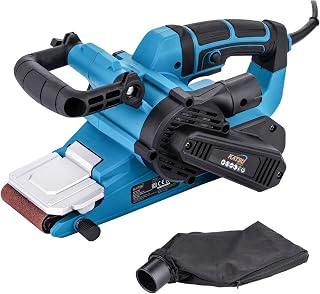
Belt sanders are designed for substantially more aggressive material removal. The continuous abrasive belt can remove timber quickly and is particularly useful for large flat surfaces, levelling uneven boards and preparing substantial areas before finer sanding.
The trade-off is control. A belt sander can remove material faster than expected, so it requires a steady technique and careful attention around edges, corners and changes in grain direction. It is usually not the first choice when the main objective is delicate finishing.
A finishing sander is generally intended for controlled surface refinement rather than heavy stock removal. These machines can be useful after coarse sanding has already flattened the workpiece and you need to progressively improve the surface before coating, staining or assembly.
Motor power is useful, but it should not be treated as a standalone measure of sanding performance. The sanding mechanism, abrasive contact, ergonomics and ability to maintain consistent operation under load can all influence real-world usefulness.
For light finishing, excessive power may provide little practical benefit. For demanding removal work, however, a motor capable of maintaining performance under sustained load can be more valuable. Compare motor output alongside the sander's intended application rather than choosing solely by the largest published number.
Variable-speed control can be valuable when working with different timber species, coatings and abrasive grades. Lower settings can provide greater control for delicate work, while higher settings may be useful when removing material more rapidly.
A fixed-speed sander can still be perfectly suitable for a specific workflow, but variable speed gives the operator more opportunity to adapt the machine to the material and task.
The abrasive contact area affects productivity. A larger sanding surface can cover broad panels more efficiently, whereas a smaller pad can make controlled work and access around tighter areas easier.
For belt sanders, belt dimensions are particularly important because they determine which replacement abrasives can be used. Before buying, check the exact abrasive size rather than assuming that similarly shaped Makita models use interchangeable belts.
Consider how quickly abrasives can be installed, removed and repositioned. Hook-and-loop systems are convenient for compatible discs and sheets, while clamp-style systems can work well with conventional sheet abrasive.
Also investigate whether the abrasives you prefer are readily available in Australia. A comparatively inexpensive sander can become less economical if its required abrasive format is inconvenient or difficult to source.
Dust management is a major consideration when sanding timber, coatings and composite materials. A sander with an effective dust collection arrangement can make the work area easier to manage and can improve visibility around the sanding surface.
Check whether the machine can connect to a suitable workshop vacuum and whether the dust port dimensions match your existing extraction equipment. Do not assume that every Makita sander uses the same connection or accessory arrangement.
A dust bag can be convenient for short jobs or situations where a vacuum is impractical. For extended sanding, a compatible extraction system may be preferable because it can provide greater capacity and reduce the amount of loose dust entering the workspace.
For professional workshops and frequent DIY use, compatibility with the dust-extraction equipment already owned may be more important than the inclusion of a basic collection bag.
Sanding often involves repetitive movement, prolonged contact with the workpiece and continuous handling of the tool. A machine that looks impressive on paper can become frustrating if its balance, grip position or vibration characteristics do not suit the operator.
Weight can be an advantage when working on a flat surface because the machine's own mass may help maintain contact. However, excessive weight becomes more noticeable during vertical sanding, overhead work or prolonged use.
Look at the complete tool rather than motor weight alone. The position of the motor, handle configuration, power cord and sanding head can influence how naturally the machine sits in the hand.
Look for a handle arrangement that allows the machine to be guided without excessive downward pressure. A comfortable grip can help maintain a consistent sanding path and reduce the temptation to force the tool against the surface.
Sanding involves repetitive movement by design, making vibration control an important comfort consideration. When comparing models, look for manufacturer-provided vibration information where available and consider the type and duration of work you expect to perform.
Because this guide focuses on corded sanders, cord management deserves attention. A longer cable can reduce the need for extension leads, while a shorter cable may be easier to manage in a compact workshop.
When an extension lead is necessary, use one appropriate for the tool's electrical requirements and intended working environment. Keep cables away from the sanding area and the path of moving materials.
Furniture projects usually benefit from controllability and surface quality rather than maximum sanding aggression. A finishing or random-orbital configuration is often more appropriate than a heavy belt sander.
For painted furniture, begin with an abrasive grade appropriate to the coating and surface condition. Avoid unnecessarily aggressive sanding when the objective is simply to create a sound surface for a new finish.
A practical workflow is to remove imperfections with a suitable coarse or medium abrasive and then progressively move toward a finer grade. The exact progression depends on the timber, coating and desired finish.
A random-orbital or finishing sander can be useful for this type of work because surface preparation generally rewards consistency rather than maximum material removal.
Large flat surfaces require a machine that can maintain consistent contact across a broad area. An orbital or random-orbital sander can be suitable for refinement, while a belt sander may be useful when substantial levelling or rapid material removal is required.
Regardless of the machine, avoid lingering in one location. Excessive dwell time can create depressions, uneven surfaces or visible sanding marks.
Removing paint, varnish or other coatings can require a different approach from ordinary timber finishing. Abrasive selection becomes particularly important because coatings can clog abrasive surfaces quickly.
Use the least aggressive method that achieves the required result, particularly on veneered or thin materials. Excessive sanding can remove more of the underlying material than intended.
When the main objective is rapid stock removal or levelling, a belt sander can have an advantage over a finishing-oriented machine. However, the operator must maintain controlled movement and avoid creating hollows.
For precision work, a slower and more controlled sanding process may produce a better final result than attempting to remove large amounts of material in a single pass.
The sander is only one part of the sanding system. Abrasive grit has a major effect on removal rate, surface appearance and the amount of finishing work required afterward.
Do not automatically start with the finest abrasive available. Fine paper removes material slowly and can be inefficient when a surface has substantial defects. Conversely, starting excessively coarse can create scratches that take considerable time to remove.
Hardwood can require controlled abrasive selection because different species respond differently to sanding. Use consistent pressure and allow the abrasive to perform the work instead of forcing the machine into the surface.
Softwood can be easier to abrade but may also show unevenness if too much pressure is applied. A heavy machine or aggressive abrasive can create unwanted dips or remove softer sections disproportionately.
Veneered panels require particular care because the visible timber layer can be relatively thin. Avoid aggressive stock-removal techniques unless you are certain the construction can tolerate them.
Paint can clog abrasives and produce dust characteristics different from bare timber. Select an abrasive appropriate for the coating and use effective extraction. When removing old coatings, also consider whether the material may require specific handling precautions.
Not every wood-focused sander should be treated as a general metalworking tool. If you intend to sand metal, verify that the particular machine, abrasive and accessory combination is explicitly suitable for that application.
Australian buyers should verify that the exact corded model is appropriate for the local electrical environment before purchasing. Check the product's stated voltage, plug configuration and Australian compliance information where applicable.
Be particularly careful when a marketplace listing combines international product information with an Australian product page. The same model name can sometimes appear in different regional configurations, so confirm the exact product designation and supplied electrical configuration.
A corded Makita sander can be attractive when uninterrupted operation is more important than portability. There is no battery charging cycle to manage, and the tool can remain connected to mains power throughout an extended sanding session.
A cordless model can make more sense when mobility, outdoor work or quick setup is the priority. The best choice therefore depends on the working environment rather than assuming that one power source is universally superior.
Makita is not the only established manufacturer worth considering. Buyers comparing professional and advanced DIY sanding equipment may also encounter Bosch Professional, DeWalt, Metabo, Festool and HiKOKI.
The right comparison should focus on the complete system rather than the logo on the housing. Evaluate the sanding mechanism, abrasive availability, dust extraction, ergonomics, replacement parts, accessories, electrical configuration and suitability for the intended workload.
More power does not automatically produce a better finish. A high-output machine can be harder to control for delicate work and may be unnecessary for occasional surface preparation.
The purchase cost is only one part of ownership. Consider abrasive consumption, compatible extraction equipment, replacement accessories, intended service life and whether the machine actually matches your workload.
Check the abrasive format before committing to a particular model. A machine may be technically excellent but inconvenient if replacement discs, sheets or belts are difficult to obtain locally.
A fast sanding action is not useful if it causes excessive rework. Productivity comes from removing the right amount of material while maintaining control and achieving the required surface quality.
Dust collection should be part of the buying decision from the beginning. Check the extraction interface and think about whether your existing vacuum or workshop dust system can be connected effectively.
A belt sander is not simply a “better” finishing sander, and a finishing sander is not a smaller replacement for a belt sander. Each machine type has a different balance of removal rate, control and surface refinement.
Pressing heavily on a sanding machine can reduce effective abrasive action, accelerate abrasive wear and create inconsistent surfaces. Let the tool's sanding mechanism and abrasive do the work while maintaining controlled movement.
When reviewing a shortlist, use the same criteria for every model. This prevents specifications that are impressive in isolation from overshadowing practical differences.
Product specification tables can contain many numbers, but not every number has equal importance for every buyer. Start with the specifications directly related to your job.
For a finishing application, sanding mechanism, pad dimensions, abrasive attachment, weight and dust extraction may matter more than maximum power. For aggressive timber removal, sanding belt dimensions, motor capability, machine handling and sustained operation may deserve greater attention.
Also distinguish between a manufacturer's technical specification and a retailer's marketing description. If two listings present conflicting information, verify the exact model number against authoritative product documentation before making a decision.
Regular maintenance can help keep a power sander performing consistently and can also reveal developing problems before they become more serious.
Consumable and wear components should be assessed separately from the main power unit. A worn pad, damaged hook-and-loop surface, deteriorated clamp or unsuitable abrasive can make a perfectly functional motor appear to perform poorly.
If the sanding accessory no longer holds securely, produces inconsistent contact or shows visible deterioration, investigate replacement options specified for the exact model. Avoid improvising incompatible components simply because their dimensions appear similar.
Safe operation should be part of the buying decision because sanding generates airborne dust, vibration and moving abrasive surfaces.
A strong long-term choice is usually the machine that fits your most frequent jobs without forcing you into an inconvenient abrasive or accessory ecosystem. Reliability matters, but so do handling, consumable availability and compatibility with the rest of your workshop.
For someone who regularly prepares furniture, doors, panels and timber components, versatility can be more valuable than extreme stock-removal performance. For someone flattening substantial timber surfaces, a belt sander may be the more appropriate specialist tool. For detailed finishing, a lighter and more controllable design can be preferable.
Prioritise ease of use, reasonable weight, readily available abrasives, effective dust collection and a sanding format that covers the majority of planned projects. There is little benefit in buying a highly specialised machine if it will only be used a few times each year.
Versatility becomes more important. A useful machine should handle repeated projects, support multiple abrasive grades and integrate conveniently with the workshop's dust extraction system.
Surface quality, control, ergonomics and abrasive flexibility are especially important. The ability to progress cleanly from preparation to finishing can matter more than maximum removal rate.
Look at portability, dust management and the ability to handle different materials and surface conditions. Renovation work can involve doors, flooring components, timber trim, painted surfaces and other variable tasks.
Prioritise machine suitability for sustained operation, ergonomics, dust extraction, consumable availability and manufacturer-supported service requirements. A tool that is comfortable and predictable over long sessions can be more valuable than one with impressive headline specifications but poor workflow compatibility.
Even an advanced machine can produce poor results when the technique is inconsistent. Start with a clean, secure workpiece and select an abrasive appropriate to the material and objective.
Keep the machine moving at a controlled pace rather than repeatedly stopping in one location. Maintain even contact and avoid pressing down unnecessarily. When working with timber, pay attention to grain direction and inspect the surface frequently rather than relying entirely on how it feels under the machine.
Progress through abrasive grades logically. Changing to a finer abrasive does not automatically remove deep scratches created by an excessively coarse previous stage, so avoid skipping too many stages when surface quality is important.
Online listings can vary considerably in the amount and accuracy of information provided. Before purchasing through an Australian retailer or marketplace, compare the exact model number across the listing, specification section and manufacturer's documentation.
There is no single Makita corded sander that is automatically best for every Australian buyer. A furniture maker, renovation enthusiast and professional timber workshop can have completely different requirements.
The strongest buying decision is therefore the one that aligns the sanding mechanism with the work. Choose a finishing-oriented machine when control and refinement dominate, a random-orbital design when versatility is the priority, and a belt sander when rapid material removal is central to the job.
Once the correct category has been identified, compare ergonomics, abrasive compatibility, dust extraction, speed control, electrical configuration and long-term consumable requirements. This approach is more useful than ranking machines solely by motor power or headline specifications.
They can be, provided the exact model has the appropriate electrical configuration and is intended for the Australian market. Always verify the specific model's voltage, plug configuration and applicable compliance information before purchasing an imported or marketplace-listed product.
A versatile random-orbital or orbital configuration is often worth considering for general woodworking because it can cover a broad range of preparation and finishing tasks. The appropriate choice still depends on the size of the workpieces and how much material needs to be removed.
Neither is universally better. A belt sander is generally the more appropriate category for aggressive material removal and levelling, while an orbital or random-orbital sander is usually easier to use for controlled finishing and surface refinement.
A corded machine provides continuous mains power, which can be advantageous for extended work. However, continuous operation should always remain within the manufacturer's operating guidance, and the tool should be kept clean and properly maintained.
Not necessarily. Motor power is only one specification. Sanding mechanism, abrasive efficiency, machine balance, dust extraction and ergonomics can all have a substantial effect on practical performance.
The appropriate grit depends on the material and objective. Coarser abrasives are generally used for greater material removal, while progressively finer abrasives are used to refine the surface. Avoid choosing a grit solely by the machine rather than the job.
A compatible workshop vacuum can be useful for controlling sanding dust, particularly during extended work. Check the exact dust-port and adapter requirements before assuming your existing extraction equipment will connect directly.
Some sanders can be suitable for preparing painted timber, but the correct abrasive and dust-control approach depends on the coating and its condition. Exercise particular caution with old or unknown coatings and follow applicable safety guidance.
Not necessarily. Similar-looking machines can require different abrasive sizes, pads, belts, clamps or extraction adapters. Verify compatibility using the exact model number.
Choose corded when continuous operation and workshop-based use are priorities. Choose cordless when mobility and freedom from a power cable are more important. Buyers already invested in a particular Makita battery platform may also value cordless compatibility, while a dedicated workshop user may prefer mains power.
Check the exact model, Australian electrical configuration, sanding type, abrasive format, dust-extraction compatibility, weight, speed control, included accessories, replacement consumables and current retailer terms. Comparing these factors gives a much clearer picture than relying on the product name alone.
Before choosing from a shortlist of advanced Makita corded sander solutions, make sure the machine meets the following practical requirements:
For an independent buying decision, compare the shortlisted Makita models against competing professional options, inspect the latest specifications, read verified customer feedback carefully and check today's Australian pricing from trusted retailers. The most suitable sander is ultimately the one that provides the right combination of removal speed, surface control, ergonomics, dust management and long-term practicality for the work you actually perform.