

♥ Wishlist
Compare 37 DeWalt Battery and Charger products in Australia. Reviews, ratings, pros, cons and buying advice updated for October 2026.


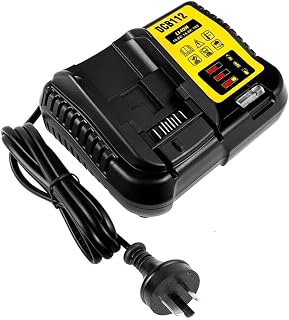


Choosing an advanced DEWALT battery and charger setup is about more than selecting the largest battery capacity available. For Australian tradespeople, contractors, maintenance teams, serious DIY users and outdoor equipment owners, the right combination needs to balance runtime, charging speed, weight, compatibility, heat management, portability and the demands of the tools being used.
DEWALT's cordless ecosystem includes batteries and chargers designed for different levels of power demand, from compact packs intended to keep drills and impact drivers lightweight through to higher-capacity solutions suited to saws, grinders, rotary hammers and other demanding applications. Understanding those differences can make a much bigger difference to day-to-day productivity than simply choosing the most expensive option.
This buying guide focuses on the technical and practical considerations that matter when comparing advanced DEWALT battery and charger solutions in Australia in 2026. Rather than assuming one battery or charger is best for everyone, the aim is to help you identify the combination that fits your tools, workload, workspace and charging routine.
A battery and charger should be considered as one system. A high-capacity battery may provide substantially more working time, but it can also add weight and bulk. A rapid charger may reduce downtime, but charging speed alone does not determine whether a particular charger is the most useful choice for your workshop or job site.
Start by identifying the tools you already own or expect to purchase. Battery-platform compatibility is one of the most important considerations because a battery must be designed for the relevant DEWALT cordless platform. Before purchasing, check the exact tool, battery and charger specifications rather than relying solely on the appearance of the battery pack.
Amp-hours, commonly abbreviated as Ah, are frequently used when comparing cordless-tool batteries. Capacity is useful for estimating how much energy a battery can store, but it should not be interpreted as a guaranteed runtime figure.
Two batteries with different Ah ratings can behave differently depending on the tool, motor, material being cut or drilled, accessory, user technique and workload. A high-demand grinder, for example, can consume considerably more energy during heavy cutting than a drill performing intermittent fastening.
A larger-capacity battery can be particularly useful when a tool is used continuously or when changing batteries frequently would interrupt work. This can be valuable for demanding saws, grinders, rotary hammers and other high-load cordless equipment.
Maximum capacity is not automatically the best choice. Compact batteries can be preferable for drills, screwdrivers, inspection work, installation tasks and jobs where the tool is held at arm's length for extended periods.
Voltage and platform compatibility should be checked before capacity. A battery that physically resembles another DEWALT pack is not necessarily interchangeable with every DEWALT cordless tool.
Buyers should identify the exact battery platform specified for their tool and then compare compatible batteries within that platform. This is especially important when moving between older and newer cordless products or when purchasing a battery for a tool that has different platform requirements.
Do not select a battery solely because its Ah rating looks attractive. The correct approach is to verify the manufacturer's compatibility information for the specific tool model and battery family.
DEWALT offers battery technologies and pack designs aimed at different performance requirements. The practical distinction for buyers is not simply battery size; it is how the pack balances energy storage, power delivery, heat behaviour, physical dimensions and weight.
Compact packs are generally attractive when portability and ergonomics are priorities. They can be useful for installation work, drilling, fastening and other applications where the operator frequently changes position or holds the tool overhead.
High-capacity packs are more appropriate when extended runtime is a priority. They can be especially useful for tools that draw significant power during repeated or continuous operation.
Advanced battery designs are intended to provide stronger performance characteristics for demanding cordless tools. When comparing these options, buyers should consider the entire tool system rather than assuming that a higher specification on the battery label automatically produces better results in every application.
Modern cordless-tool batteries commonly use lithium-ion technology because it offers a useful combination of energy density, relatively low weight and rechargeable performance. However, battery chemistry is only one part of the overall design.
Internal cells, electronic controls, thermal management, construction quality and communication between the battery and tool can all influence how a battery behaves under load. Advanced battery packs may incorporate electronic systems designed to monitor operating conditions and help manage performance.
For consumers, the most useful takeaway is simple: compare the complete battery system rather than judging a battery solely by its capacity rating.
Runtime varies considerably in real-world use. A battery used in a drill for occasional fastening can last very differently from the same battery used in a high-load application.
Factors affecting runtime include:
For that reason, avoid treating Ah ratings as an exact prediction of hours of operation. Use capacity as one comparison point and consider your actual workload pattern as the more important factor.
The charger is an important part of the cordless system because charging speed, compatibility, portability and charging location all influence how practical a battery setup becomes.
A suitable charger should be compatible with the relevant DEWALT battery family and appropriate for the user's charging routine. Someone who charges batteries overnight may have different priorities from a contractor who needs to rotate several packs during a working day.
Faster charging can reduce downtime when batteries are being used continuously. However, the fastest charger is not necessarily the best purchase if most batteries are charged between jobs or overnight.
A single-battery charger can be adequate for occasional users and compact workshops. Its smaller footprint may also be useful where storage space is limited.
Users operating several cordless tools may benefit from a charging arrangement that supports multiple batteries. This can simplify battery rotation and reduce the risk of arriving at a job with every pack depleted.
For mobile tradespeople, a compact charger may be easier to transport between workshops, vehicles and job sites. For a fixed workshop, size and portability may matter much less than charging capacity and organisation.
Temperature deserves particular attention in Australia. High ambient temperatures can affect rechargeable battery operation, and charging or using batteries in unsuitable conditions should be avoided.
Follow the manufacturer's instructions for operating and charging temperature ranges. Do not assume that a battery should immediately be placed on a charger after demanding use simply because it is convenient to do so. If a pack is unusually hot, allow it to return to an appropriate condition according to the manufacturer's guidance.
Battery systems used in Australian workshops and construction environments can face dust, heat, transport between locations and frequent handling. A good buying decision therefore considers durability and practicality alongside electrical specifications.
For professional users, it can be useful to maintain a battery rotation system. Instead of waiting until every pack is depleted, keep charged batteries available while depleted packs move into the charging cycle. This approach can be more effective than relying on one extremely large battery.
Tradespeople should prioritise compatibility across the cordless tools they use most frequently. A consistent DEWALT battery platform can reduce the number of chargers, battery types and accessories that need to be transported.
A workshop user may place greater emphasis on charging organisation, storage and having enough batteries available for multiple tools. If mains power is readily accessible, the value of additional battery capacity may differ from that of a mobile user.
Occasional users should avoid paying for capacity they are unlikely to use. A compact battery and appropriate charger can often be more practical when tools are used for short household projects rather than continuous professional work.
There is no universal number. The ideal quantity depends on how many cordless tools are used simultaneously, how frequently the tools are used and how quickly the available charger can replenish depleted packs.
A useful purchasing principle is to build a battery rotation around your actual workflow. If one battery is constantly waiting for a charge, adding another compatible pack may provide more practical benefit than replacing the existing battery with a substantially larger model.
One of the most overlooked buying decisions is the trade-off between runtime and ergonomics. More stored energy usually means a physically larger or heavier battery, although exact weight varies by battery design.
For ground-level cutting or other demanding tasks, additional battery weight may be less noticeable than it would be during prolonged overhead drilling. Conversely, a compact battery may need to be changed more frequently.
Consider the physical position of the tool during normal use. If a tool is regularly held above shoulder height, at full arm extension or in awkward spaces, ergonomics should carry significant weight in the buying decision.
DEWALT has multiple cordless platforms and product generations. Always verify compatibility for the exact tool and battery combination.
Maximum capacity can add weight and cost without providing meaningful advantages for light-duty applications. Match capacity to the workload instead.
A battery purchase should include a compatibility check for the charger. If the charger does not support the relevant battery platform, the battery may not provide the expected convenience.
Runtime depends on application and operating conditions. Treat stated capacity as a specification rather than a guaranteed number of working hours.
Battery packs are not simple passive accessories. They involve cells, electrical connections and control electronics. Buyers should exercise caution with batteries that are not clearly intended and approved for their particular tool system.
A battery may appear inexpensive when considered by itself, but the overall cost can include chargers, additional packs, storage and replacement requirements. Compare the complete setup rather than a single component.
When comparing several advanced solutions, use the following checklist to create an objective shortlist.
For buyers who are not already committed to a battery platform, it can be useful to compare DEWALT with other established professional cordless ecosystems such as Milwaukee, Makita, Bosch Professional and Metabo. The comparison should focus on the tools and batteries required for your specific work rather than assuming one brand is universally superior.
Once a user owns several cordless tools from one ecosystem, the value of platform compatibility becomes increasingly important. Buying into a second ecosystem can mean purchasing additional batteries and chargers, while staying within one system can simplify transport and charging.
Compare the specific cordless tool ranges, battery technologies, tool availability and ergonomics relevant to your work. Both brands have extensive professional-oriented cordless portfolios, but the best choice depends on the individual tools and applications you need.
Makita is another major cordless-tool manufacturer with broad battery-platform coverage. Buyers should compare the exact tool categories they require, along with battery capacity, tool weight and charging arrangements.
Bosch Professional provides another established cordless ecosystem. Platform compatibility and the breadth of tools required should be considered before committing to a battery system.
Metabo is particularly relevant to users who require professional-grade power tools and want to compare different approaches to cordless equipment. As with any platform comparison, assess the complete ecosystem rather than one battery specification.
Proper storage can help protect a rechargeable battery system and reduce avoidable wear. Always follow the manufacturer's instructions because storage recommendations can vary by battery design.
Rechargeable batteries naturally experience wear over repeated use. A noticeable reduction in useful runtime can be one indication that a battery is approaching the end of its practical service life.
Physical damage is a separate and more serious consideration. Swelling, cracking, leaking, severe impact damage, overheating or other unusual behaviour should not be ignored. A damaged lithium-ion battery should not simply be returned to normal use because it still appears to hold a charge.
For safety-related decisions, follow DEWALT's instructions and applicable Australian battery disposal and recycling guidance rather than attempting to repair or modify a damaged battery pack yourself.
Battery charging should be treated as part of normal workshop safety. Use the correct charger, inspect the equipment and follow the manufacturer's instructions.
A well-planned rotation can be more useful than buying batteries at random. Consider separating your packs into three groups: batteries currently in use, charged batteries ready for use and batteries undergoing charging.
For a professional workflow, this can reduce interruptions during periods of intensive cordless-tool use. For a home workshop, a smaller rotation may be sufficient.
The appropriate capacity depends on the tool and the way it is used. There is no single Ah rating that is best across an entire cordless workshop.
The cheapest battery is not necessarily the best value, and the largest battery is not necessarily the most economical. Value should be assessed against expected usage.
For frequent users, a battery that reduces interruptions and works across several compatible tools may provide greater practical value than a cheaper pack with limited usefulness. For occasional users, spending significantly more for maximum capacity may offer little benefit.
When checking today's Australian pricing, compare the battery-only option with kits that include a charger. Also check whether you already own a compatible charger before purchasing another one unnecessarily.
If you already have compatible DEWALT batteries and chargers, expanding the existing system can often be simpler than creating a separate charging ecosystem. Before purchasing, determine whether your current batteries meet the demands of the tool you are adding.
Replacement decisions should also account for battery condition. If an older pack has substantially reduced runtime, replacing it may be more useful than continually adding additional low-capacity batteries to compensate for reduced performance.
Product listings can contain a large amount of technical information. Focus on specifications that directly affect your use case.
Customer ratings can be useful, but a star rating alone does not explain whether a battery is suitable for your application. Read reviews for details about the circumstances in which the product was used.
Look for recurring comments concerning battery fit, tool compatibility, charging behaviour, runtime expectations, weight, durability and ease of use. Give greater attention to specific observations than vague statements such as "great battery" or "poor product."
Also distinguish between reviews discussing the battery itself and reviews discussing a tool kit, charger or unrelated component. This helps prevent an attractive rating from influencing a decision for the wrong reason.
Advanced battery solutions are most compelling for users who rely heavily on cordless tools and need a combination of power, runtime and efficient battery management.
Occasional users may not benefit from the most expensive or highest-capacity battery available. If a drill is used for a few short household tasks each month, a compact compatible battery can be more practical than a large high-capacity pack.
The same principle applies to chargers. If batteries are normally charged overnight and there is no need for rapid turnaround, paying extra for charging speed may not improve the overall experience significantly.
The strongest approach is to start with the tool, not the battery. Identify the cordless tools that consume the most energy, determine the battery platform they require and then build a battery rotation around those tools.
For a mixed workshop, consider keeping compact packs for lightweight tasks and higher-capacity packs for demanding equipment. This avoids forcing one battery size to perform every job.
For professional users, having enough batteries to maintain a continuous rotation can be more valuable than owning one exceptionally large battery. A charger should then be selected according to how quickly the rotation needs to be replenished.
The best battery depends on the exact DEWALT tool, required runtime, workload and preferred balance between power, capacity and weight. There is no single battery that is ideal for every cordless application.
No. A higher Ah rating can provide more stored energy, but it can also increase weight and physical size. For lightweight tools and overhead work, a smaller compatible battery may be preferable.
Do not assume universal compatibility. Check the manufacturer's specifications for the exact battery and charger combination before purchasing or charging a pack.
A kit can be useful when you need both components, particularly if the included battery capacity suits your tools. If you already own a compatible charger, buying a battery separately may avoid unnecessary duplication.
It depends on workload. Occasional users may need only a small number, while professionals who use several cordless tools throughout the day may benefit from a larger rotation.
Battery capacity and power delivery are related but not identical concepts. A larger Ah rating primarily indicates greater stored energy. Tool performance depends on the complete battery, tool and electronic system.
Follow the manufacturer's storage instructions and protect batteries from unsuitable temperatures, moisture, direct prolonged heat exposure and physical damage. Avoid leaving lithium-ion battery packs in excessively hot locations such as vehicles for extended periods.
Do not continue using a battery that is visibly damaged, swollen, leaking, severely impacted or behaving abnormally. Follow DEWALT's safety instructions and appropriate Australian disposal or recycling guidance.
DEWALT offers cordless tools and battery systems aimed at professional applications, but suitability should always be assessed against the exact tool, workload and working environment.
There is no universal winner. DEWALT, Milwaukee and Makita all offer extensive cordless ecosystems. Compare the exact tools, battery platforms, ergonomics, charging arrangements and overall system requirements relevant to your work.
Use compatible batteries across as many of your required tools as practical, match battery capacity to workload, avoid buying unnecessary duplicate chargers and maintain enough battery capacity to support your normal working routine.
The right advanced DEWALT battery and charger solution is the one that fits the tools you actually use and the way you actually work. High capacity is valuable for demanding applications, while compact packs can deliver better ergonomics for lighter tasks. Similarly, rapid charging can be highly useful for intensive professional workloads but may provide limited additional value for occasional users.
For Australian buyers in 2026, the most sensible comparison is therefore a complete cordless system: battery platform, capacity, power requirements, weight, charger compatibility, charging speed, storage and long-term practicality. Compare those factors carefully, check the manufacturer's specifications for the exact models under consideration, and then compare current Australian retailer prices and verified customer feedback before making a final decision.