
♥ Wishlist
Compare 31 Bosch Jigsaws for Precise Cutting in Australia products in Australia. Reviews, ratings, pros, cons and buying advice updated for October 2026.




Choosing an advanced Bosch jigsaw is less about finding the highest wattage or the largest advertised cutting depth and more about matching the machine's cutting system, grip design, power source, blade control, dust management and intended workload to the work you actually do. Bosch's Professional range includes corded and cordless jigsaws aimed at different levels of precision and cutting capacity, while Bosch DIY offers simpler 18V models for home projects.
For Australian buyers, the distinction between Bosch Professional and Bosch DIY is particularly important. A tradesperson, cabinetmaker, carpenter or serious workshop user may benefit from the higher cutting capacity, brushless drive systems, precision blade guidance and professional accessory ecosystem of the Professional range. A homeowner cutting shelving, laminate, timber panels or other thinner materials may have little reason to pay for those advanced features.
The current Bosch range illustrates the difference clearly. The Professional GST 18V-155 SC and GST 18V-155 BC are 18V cordless jigsaws with a 155 mm maximum cutting depth in wood, while the GST 18V-125 family provides up to 125 mm in wood. Bosch's corded GST 160 CE is rated at 800 W and is designed around precision cutting, while the GST 150 BCE uses a 780 W motor and is positioned for demanding applications. :contentReference[oaicite:0]{index=0}
The following models represent useful comparison points across Bosch's advanced, professional and higher-capability jigsaw categories. They should not be treated as a claim that every model is universally better than every other model. The right choice depends on whether your priority is precision, deep cutting, cordless mobility, control, endurance, portability or value.
The GST 18V-155 SC is one of the most technically sophisticated Bosch cordless jigsaws to consider for demanding work. It uses an 18V battery platform, a brushless motor and a barrel-grip configuration. Bosch lists a 155 mm cutting depth in wood, 20 mm in aluminium, a 26 mm stroke height and a no-load stroke rate of 800–3,800 strokes per minute. The tool weighs approximately 2 kg without the battery. :contentReference[oaicite:1]{index=1}
The barrel grip is especially relevant when the direction and position of the cut require more flexible hand placement. Bosch describes the design as allowing a 360-degree gripping circumference, with a double-sided switch intended to improve control for right- and left-handed users and for awkward cutting positions. The blade guidance system is designed to reduce blade bending, which matters when making curved or detailed cuts where a blade can otherwise wander from the intended line. :contentReference[oaicite:2]{index=2}
The GST 18V-155 SC also brings connected-tool functionality and Adaptive Speed Control. Bosch describes the system as helping with controlled starting of cuts, while individual speed and light settings can be managed through the Bosch Toolbox ecosystem. This is a feature set aimed more at precision-focused professional work than occasional DIY. :contentReference[oaicite:3]{index=3}
The GST 18V-155 BC provides much of the same high-capacity cordless cutting proposition as the SC but uses a bow-handle configuration. Bosch lists an 18V battery voltage, 155 mm wood cutting depth, 20 mm aluminium cutting depth, 26 mm stroke height and a no-load stroke rate of 0–3,800 spm. The stated tool weight without the battery is approximately 2 kg. :contentReference[oaicite:4]{index=4}
The bow-handle format can be preferable if you naturally control a jigsaw from above and prefer a conventional top-handle posture. Bosch's own comparison material positions the 155-series bow and barrel versions as alternatives for different handling requirements rather than fundamentally different cutting capacities. Both models use brushless motors and are part of the Professional 18V ecosystem. :contentReference[oaicite:5]{index=5}
The BC also provides an accelerator switch for controlling cutting speed through the trigger. That can be useful when beginning a cut, entering a marked curve or deliberately slowing the blade to improve control.
The GST 18V-125 S is a strong alternative when you want cordless professional capability but do not need the full 155 mm cutting capacity of the flagship 155-series. The S designation identifies the barrel-grip configuration. Bosch describes the model as suitable for curved and cross cuts in solid wood, chipboard and wood composites, including thicker or harder materials. :contentReference[oaicite:6]{index=6}
Bosch's technical documentation specifies a maximum wood cutting depth of 125 mm, a 26 mm stroke height and a no-load stroke range of 800–3,500 spm for the barrel-grip GST 18V-125 S. The bow-handle GST 18V-125 B has a 0–3,500 spm range. :contentReference[oaicite:7]{index=7}
The model supports four-stage orbital action, speed selection, an SDS blade-changing system, LED illumination and dust-blowing functionality. Its baseplate can be adjusted to 45 degrees for bevel cuts, and Bosch specifies a removable plastic overshoe for protecting sensitive workpieces. :contentReference[oaicite:8]{index=8}
The GST 18V-125 B is the bow-handle counterpart to the GST 18V-125 S. It makes sense for buyers who want the same general 125 mm professional cordless cutting class but prefer a conventional top handle. Bosch's technical documentation gives the model a 0–3,500 spm no-load stroke range and 26 mm stroke height. :contentReference[oaicite:9]{index=9}
The important buying decision here is not simply S versus B. Think about how you normally hold a jigsaw, whether you frequently work beneath a workpiece, whether visibility around the blade is important and how much control you prefer over the tool body. Grip geometry can affect fatigue and accuracy even when two machines have similar cutting specifications.
The GST 185-LI is another 18V cordless option aimed at curved and cross cuts in solid wood, chipboard and wood composites. Bosch specifies a brushless motor, a 125 mm wood cutting depth, 20 mm aluminium cutting depth, 26 mm stroke height and a no-load stroke rate of up to 3,500 spm. The tool weight excluding the battery is approximately 2 kg. :contentReference[oaicite:10]{index=10}
Its four-stage orbital action allows the cutting behaviour to be adjusted between faster material removal and cleaner cutting. Speed selection allows the operator to adapt the tool to different applications rather than simply running at maximum speed all the time. :contentReference[oaicite:11]{index=11}
For buyers comparing it with the GST 18V-155 models, the most obvious numerical difference is cutting depth: 125 mm versus 155 mm in wood. That does not automatically make the 155-series the better purchase. If your normal material thickness is comfortably below 125 mm, the additional capacity may provide little practical benefit.
The GST 160 CE is a precision-oriented corded jigsaw. Bosch lists an 800 W motor, a 26 mm stroke length, an 800–3,000 spm no-load stroke rate and a weight of approximately 2.2 kg for the CE version. Its maximum wood cutting depth is 160 mm, with Bosch documentation specifying 20 mm in aluminium and 10 mm in unalloyed steel. :contentReference[oaicite:12]{index=12}
Its design is particularly interesting for precision work. Bosch describes a narrow grip and barrel-grip configuration intended to improve control, while a double-roller blade guidance system is designed to reduce blade bending. The machine also supports constant-speed operation, speed selection, precision control, orbital action, LED illumination, bevel cuts and tool-free SDS blade changes. :contentReference[oaicite:13]{index=13}
For workshop users who have reliable access to mains power, the GST 160 CE demonstrates why a corded jigsaw can remain attractive even as high-performance cordless tools become increasingly capable. There is no battery capacity to manage during a long stationary cutting session, and the tool can be selected around continuous workshop use rather than mobility.
The GST 160 BCE shares the 160-series precision platform but uses a bow-handle configuration. Bosch's documentation identifies an 800 W rated input, a 26 mm stroke, 800–3,000 spm no-load stroke rate and approximately 2.3 kg weight for the BCE version. :contentReference[oaicite:14]{index=14}
The BCE variant is worth considering if you prefer the additional leverage and familiar handling position of a bow handle while still wanting the precision-focused mechanical design of the 160-series. Bosch lists LED lighting, precision control, speed selection, orbital action, constant speed and tool-free SDS blade changes among its features. :contentReference[oaicite:15]{index=15}
When comparing the CE and BCE versions, concentrate on ergonomics rather than assuming one is categorically more powerful. The core 800 W platform and 160 mm wood cutting capability make them members of the same high-capacity class.
The GST 150 BCE is a robust corded alternative for demanding cutting. Bosch specifies a 780 W motor, 500–3,100 spm no-load stroke rate, 26 mm stroke length and approximately 2.7 kg weight. Bosch describes the bend-resistant sole plate as being designed for tough applications and the motor's constant-speed operation as suitable for difficult materials and thick beams. :contentReference[oaicite:16]{index=16}
The model is designed for curved cutting in solid wood, chipboard and wood composites. It also supports bevel cuts, orbital action, speed selection, a blower and tool-free SDS blade changes. Bosch lists compatibility with its Click & Clean system and other Bosch vacuum cleaners. :contentReference[oaicite:17]{index=17}
The GST 150 BCE can therefore be a sensible choice when durability and high-capacity corded cutting are more important than having the latest cordless connectivity features. Its 780 W input and 150 mm wood cutting depth place it firmly in the heavy-duty category.
The GST 90 BE represents the more accessible end of Bosch's Professional corded jigsaw range. Bosch lists a 650 W motor, a 500–3,100 spm no-load stroke rate, approximately 2.6 kg weight and a 2.5 m cable in the documented configuration. :contentReference[oaicite:18]{index=18}
It is intended for curved cutting in solid wood, chipboard and wood composites and includes bevel capability, a blower, orbital action and speed selection. Tool-free Bosch SDS blade changes are another practical advantage when changing between different blade types. :contentReference[oaicite:19]{index=19}
For buyers who do not need the extreme cutting depth or advanced connected features of the 155-series, the GST 90 BE illustrates an important buying principle: professional quality does not necessarily mean choosing the most expensive specification. A simpler tool can be more appropriate when the work does not justify additional features.
The EasySaw 18V-70 is a Bosch DIY cordless jigsaw rather than a Professional-series machine, so it should be considered as a practical alternative for homeowners rather than as a direct competitor to the GST 18V-155 range. Bosch Australia describes it as a compact cordless jigsaw intended for interior DIY and creative projects. :contentReference[oaicite:20]{index=20}
Its specifications include an 18V battery platform, 0–2,600 spm stroke rate, 70 mm wood cutting depth, 6 mm steel cutting depth and 15 mm aluminium cutting depth. The stated tool weight excluding the battery is 1.30 kg. :contentReference[oaicite:21]{index=21}
The EasySaw 18V-70 uses the Bosch 18V POWER FOR ALL ALLIANCE battery platform. That distinction is important because Bosch's consumer 18V ecosystem is separate from the Bosch Professional 18V platform used by professional GST models. A buyer should therefore check battery compatibility before assuming that an existing Bosch 18V battery will fit every Bosch jigsaw.
The two 155-series models are among the most important comparisons for a buyer seeking an advanced Bosch cordless jigsaw. Their cutting specifications are closely aligned: both operate at 18 V, both have a 26 mm stroke, both can cut up to 155 mm in wood, 20 mm in aluminium and 10 mm in unalloyed steel, and both use a brushless motor. :contentReference[oaicite:22]{index=22}
The numerical difference is straightforward: the 155-series is rated for 155 mm maximum cutting depth in wood, while the 125-series is rated for 125 mm. Both are 18V cordless Professional jigsaws, but the 155-series is designed around a higher-capacity precision proposition. :contentReference[oaicite:23]{index=23}
That extra 30 mm should not automatically determine the purchase. Consider the thickness of the material you actually cut. If most of your work involves plywood, cabinetry panels, laminate, shelving or timber substantially below 125 mm, the additional capacity may rarely be used. Conversely, if you routinely cut thick hardwood, structural timber or other deep sections, the larger cutting envelope can provide useful headroom.
The GST 160 family is the more precision-oriented choice of the two. Bosch specifies an 800 W motor and 160 mm maximum wood cutting depth, with the CE model incorporating double-roller blade guidance designed to reduce bending. :contentReference[oaicite:24]{index=24}
The GST 150 BCE uses a slightly lower 780 W input and 150 mm wood cutting capacity, while emphasising robust construction and a bend-resistant sole plate. :contentReference[oaicite:25]{index=25}
For precision joinery, controlled curves and applications where blade guidance is particularly important, the GST 160 family deserves closer attention. For demanding general cutting where rugged construction and high-capacity performance are priorities, the GST 150 BCE can be a more logical comparison.
The word advanced should not be interpreted as simply meaning more powerful. A sophisticated jigsaw combines several systems that influence the quality and repeatability of the finished cut.
Brushless motors are used in Bosch's advanced cordless GST models such as the GST 18V-155 SC, GST 18V-155 BC and GST 185-LI. :contentReference[oaicite:26]{index=26}
For the buyer, the important point is not to assume that "brushless" automatically means a particular cutting result. Instead, evaluate it alongside the tool's mechanical system, blade guidance, speed control, battery platform and intended workload.
Variable speed gives the operator more control over how aggressively the blade moves through a material. High speed can be useful for suitable wood-cutting applications, while slower settings may provide greater control when starting a cut or working with materials that require a more deliberate cutting rate.
Orbital action changes the movement of the blade so that the cutting stroke has a more pronounced forward component. Bosch's professional jigsaws provide selectable orbital settings on applicable models. The practical decision is whether you want faster material removal or a smoother, more controlled cut. Higher orbital action is not automatically better for finish quality.
Blade guidance becomes increasingly important as the cut becomes deeper, more curved or more precision-critical. Bosch highlights specialised blade guidance on the GST 160 and GST 18V-155 families. The purpose is to reduce unwanted blade movement and improve control over the cut path. :contentReference[oaicite:27]{index=27}
Constant-speed electronics can help maintain the selected cutting behaviour under load. This is especially relevant when cutting thicker material where simply choosing a high no-load speed does not guarantee the same cutting behaviour once the blade encounters resistance.
Frequent blade changes are normal when a jigsaw is used for different materials and finish requirements. Bosch's SDS system is designed to make blade changes without a separate tool. :contentReference[oaicite:28]{index=28}
The jigsaw itself is only one part of the cutting system. Blade selection can have a major influence on cutting speed, finish, accuracy, vibration and the risk of damaging the workpiece.
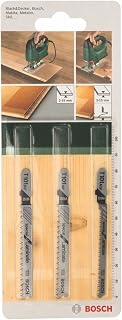
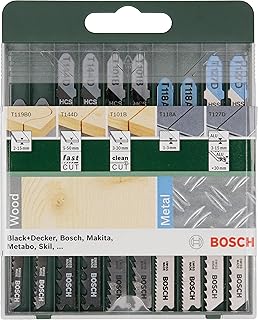
Wood blades vary in tooth geometry, tooth spacing, thickness and intended finish. Coarser teeth can be appropriate when rapid material removal is more important than a fine edge. Finer-tooth blades can be more appropriate for clean cuts in sheet materials or visible surfaces.
Bosch's own product documentation references blade families such as T 144 D, T 144 DP, T 244 D and T 308 variants across its jigsaw range. The specific blade should be selected according to the material, thickness and desired finish rather than simply choosing the blade supplied in the box. :contentReference[oaicite:29]{index=29}
Metal requires a blade designed for the material rather than a general-purpose wood blade. Tooth density and cutting speed become particularly important because metal can generate substantially different cutting resistance and heat.
When cutting laminated boards, veneered panels or visible cabinet components, a blade intended for a cleaner finish can be more valuable than maximum cutting speed. Support the workpiece properly and use the correct cutting direction for the specific blade and material.
A blade needs enough usable length to pass through the workpiece throughout the stroke. However, choosing an unnecessarily long blade can increase flexibility and make control more difficult. The blade should be appropriate for the material thickness and the jigsaw's specified cutting capability.
Maximum cutting depth is one of the easiest specifications to compare, but it is also one of the easiest to misunderstand. A manufacturer's maximum figure represents a specified capability under defined conditions; it should not be interpreted as a guarantee that every material can be cut at that depth with identical speed, accuracy or finish.
For example, the GST 18V-155 models are specified at 155 mm in wood, 20 mm in aluminium and 10 mm in unalloyed steel. Those three numbers are not interchangeable because the cutting behaviour, blade selection and resistance of each material are different. :contentReference[oaicite:30]{index=30}
When comparing jigsaws, consider four separate questions:
There is no universal winner. Bosch's Professional 18V ecosystem now includes high-capacity jigsaws such as the GST 18V-155 SC and BC, while corded models such as the GST 160 CE and GST 150 BCE remain relevant for workshop and demanding applications. :contentReference[oaicite:31]{index=31}
One of the most important mistakes to avoid is assuming that every Bosch 18V battery belongs to the same ecosystem. Bosch DIY Australia identifies the EasySaw 18V-70 as part of the 18V POWER FOR ALL ALLIANCE, while Bosch Professional cordless GST models use the Professional 18V system and are also associated with AMPShare compatibility. :contentReference[oaicite:32]{index=32}
Before purchasing a bare cordless jigsaw, identify the exact battery platform already in your workshop. Check the product's official specification rather than relying on the voltage number alone. Two batteries can both be labelled 18V while belonging to different systems and having incompatible physical interfaces.
Australian woodworking can involve dense hardwoods and demanding cutting conditions. When selecting a jigsaw for hardwood, focus on mechanical control rather than simply looking for the highest advertised speed.
A large cutting-depth number should not be the only criterion. A jigsaw that offers better control with the appropriate blade can produce a more useful result than a theoretically more powerful machine operated with the wrong blade or cutting setting.
Cabinetmaking places a premium on accuracy and surface quality. The ability to cut quickly through thick timber is less important than maintaining a controlled path through sheet goods and visible components.
Blade guidance and a rigid base can help maintain the intended path. Bosch specifically highlights precision-oriented blade guidance in the GST 160 and GST 18V-155 series. :contentReference[oaicite:33]{index=33}
For visible edges, select a blade designed for clean cutting rather than assuming the fastest blade is the best option.
Dust can obscure the cutting line and make accurate marking harder to see. Bosch Professional jigsaws such as the GST 150 BCE, GST 160 CE and GST 18V-155 models provide compatibility or provisions for dust extraction. :contentReference[oaicite:34]{index=34}
A suitable parallel guide can assist with controlled straight or circular cuts. Bosch lists a parallel guide compatible with numerous GST and PST models, including the GST 90, GST 150 and GST 160 families. Compatibility should always be confirmed for the exact tool variant before purchase. :contentReference[oaicite:35]{index=35}
If your work rarely exceeds 50–70 mm material thickness, a 155 or 160 mm cutting capacity may offer little practical advantage. The extra capability can add cost and complexity without improving your normal projects.
Input power is useful information for corded tools, but it does not describe the complete cutting system. Blade guidance, speed control, stroke characteristics, orbital action, ergonomics and blade quality all affect the final result.
A barrel grip and bow handle can feel substantially different in actual use. If you regularly make inverted cuts or detailed curves, grip geometry deserves as much attention as headline specifications.
A cordless jigsaw sold without a battery can look inexpensive until the cost of a compatible battery and charger is added. Conversely, a bare tool can be excellent value if you already own compatible batteries.
Check whether the jigsaw belongs to Bosch Professional 18V or the consumer-focused POWER FOR ALL system before buying. The voltage designation alone is insufficient.
Even a high-end jigsaw can deliver disappointing results with an inappropriate blade. Match the blade to the material, thickness and finish requirement.
Different retail configurations can contain different blades, cases, dust-extraction components, batteries or chargers. Compare the complete contents rather than comparing the headline product name alone.
A useful comparison process is to score each model against the actual work you expect it to perform.
A precise blade cannot compensate for an inaccurate layout. Use an appropriate marking method for the material and make sure the reference line remains visible during cutting.
Unsupported sheet material can vibrate or move, making an accurate cut difficult. Secure the workpiece while leaving enough clearance for the blade and baseplate.
Excessive forward pressure can cause the blade to deflect, particularly in curves or thicker materials. Maintain controlled feed pressure and allow the selected blade and cutting setting to determine the pace.
Reducing speed at the beginning of a cut can make it easier to establish the blade on the intended line. Advanced Bosch cordless models provide sophisticated speed-control functions specifically aimed at improving control during demanding cuts. :contentReference[oaicite:36]{index=36}
More aggressive orbital movement can increase cutting efficiency, but it is not necessarily ideal for every visible edge. Reduce the orbital setting when surface quality and control are more important than rapid material removal.
The sole should remain properly seated against the workpiece. Tilting the tool unintentionally can introduce an inaccurate bevel even when the baseplate itself is set to the correct angle.
Dust management is both a practical and visibility issue. Sawdust can cover the cut line, reduce the operator's ability to see the blade and accumulate around the work area. Bosch Professional specifies Click & Clean compatibility on several of its corded jigsaws, including the GST 90 BE and GST 150 BCE, while advanced cordless models provide dust-extraction provisions. :contentReference[oaicite:37]{index=37}
When comparing packages, distinguish between a jigsaw being compatible with dust extraction and a complete vacuum-extraction setup being supplied. Package contents can vary between variants.
Always read the manufacturer's operating instructions for the exact model before use. A jigsaw should be operated with appropriate personal protective equipment and in accordance with the instructions supplied with the tool and blade.
Bosch's published documentation for its advanced cordless jigsaws also provides noise and vibration information and specifically advises hearing protection for the tested conditions. :contentReference[oaicite:38]{index=38}
Remove accumulated dust and debris from the blade area and baseplate according to the manufacturer's instructions. Build-up around moving components can interfere with smooth operation.
A damaged, blunt or unsuitable blade can increase cutting resistance and reduce control. Replace blades when their condition no longer supports safe, controlled cutting.
The baseplate should remain flat and secure. If it becomes damaged or does not lock correctly at the required angle, discontinue use until the issue has been addressed according to the manufacturer's service instructions.
Do not allow dust to block the motor cooling openings. Clean the tool using the method specified in the operating instructions rather than introducing liquids into the power-tool housing.
Use the correct Bosch battery and charger system for the tool. Follow the manufacturer's charging, storage and temperature guidance rather than treating the battery as a generic 18V power source.
The right accessories can change what a jigsaw can do and how accurately it can perform the task. Common accessories include parallel guides, circle-cutting attachments, guide-rail adapters, dust-extraction components, anti-splinter guards, protective overshoes and carrying cases.
Bosch lists a parallel guide compatible with a broad selection of GST and PST models, including the GST 90 BE, GST 150 BCE and GST 160 CE, as well as selected Bosch DIY jigsaws. Exact compatibility should be confirmed against the part number and model before purchase. :contentReference[oaicite:39]{index=39}
An anti-splinter guard can help support the material around the blade and reduce splintering in appropriate applications. It is particularly useful when working with sheet goods where edge appearance matters.
A protective overshoe can be valuable when cutting surfaces that could be marked by the metal baseplate. Bosch specifies a removable plastic overshoe on relevant GST cordless models. :contentReference[oaicite:40]{index=40}
Guide systems can be useful when a jigsaw needs to follow a controlled path. Not every guide rail is automatically compatible with every jigsaw, so verify the correct adapter and manufacturer's compatibility information before purchasing.
These descriptions are application-based comparisons rather than independent test rankings. Bosch's published specifications establish the differences in capacity, power system, grip design and features; the best choice still depends on the buyer's work requirements.
Australian shoppers should compare the exact model number rather than relying only on a product-family name. Bosch often offers multiple configurations of the same basic tool, with differences in voltage, included blades, battery packs, carrying cases, dust-extraction accessories and other components. Official Bosch Australia listings demonstrate this variation across the GST 18V-155 SC and GST 18V-155 BC configurations. :contentReference[oaicite:41]{index=41}
For cordless models, determine whether you need a bare tool or a complete kit. If you already own suitable Professional 18V batteries, a bare tool can make sense. If you are entering the platform for the first time, compare the combined cost of the tool, battery and charger rather than the tool-only figure.
For corded models, confirm the Australian electrical specification and exact local model variant. Bosch documentation shows that the same product family can have different voltage variants in different markets, making model verification especially important for Australian purchases. :contentReference[oaicite:42]{index=42}
Retail prices can change, promotional packages can differ and availability can vary between Australian retailers. Rather than treating the lowest headline price as the best deal, compare the complete package.
This approach prevents a common affiliate-shopping mistake: comparing two listings that look identical in a search result but contain materially different accessories.
Customer reviews can be useful, but they are most valuable when read for recurring practical observations rather than star rating alone. When evaluating reviews for a Bosch jigsaw, look for comments concerning:
A review from someone cutting thin MDF occasionally should not be treated as equivalent evidence to a review from a tradesperson repeatedly cutting thick hardwood. Context matters.
There is no single best model for every professional. The GST 18V-155 SC and GST 18V-155 BC are compelling advanced cordless options, while the GST 160 CE/BCE and GST 150 BCE provide high-capacity corded alternatives. The choice should be based on grip preference, required cutting depth, mobility and precision requirements. :contentReference[oaicite:43]{index=43}
Choose the 155 SC when its additional cutting capacity and advanced control features are genuinely useful. The GST 18V-155 SC reaches 155 mm in wood, compared with 125 mm for the GST 18V-125 S. If your projects rarely approach 125 mm thickness, the less-capable model may already provide enough capacity. :contentReference[oaicite:44]{index=44}
The primary ergonomic distinction is the grip: SC uses a barrel grip while BC uses a bow handle. Both provide 155 mm maximum wood cutting depth, 26 mm stroke height and an 18V Professional platform. :contentReference[oaicite:45]{index=45}
Do not assume they are interchangeable simply because both are labelled 18V. Bosch identifies the EasySaw 18V-70 with the 18V POWER FOR ALL ALLIANCE, whereas Bosch Professional GST cordless models belong to the Professional 18V ecosystem. Check the exact battery platform before purchasing. :contentReference[oaicite:46]{index=46}
Yes, particularly for workshop users who value continuous mains operation, high cutting capacity and do not need cordless mobility. Models such as the GST 160 CE and GST 150 BCE remain technically capable corded choices. :contentReference[oaicite:47]{index=47}
Look toward higher-capacity models such as the GST 18V-155 series, GST 160 family and GST 150 BCE. The GST 18V-155 models provide 155 mm maximum wood cutting depth, while the GST 160 models are specified at 160 mm and the GST 150 BCE at 150 mm. :contentReference[oaicite:48]{index=48}
No. Cutting speed depends on the material, blade geometry, blade condition, orbital setting, feed pressure and tool design as well as stroke rate. A higher no-load stroke figure is therefore only one part of the comparison.
Brushless technology is particularly relevant when considering Bosch's advanced cordless Professional models. However, the best purchase depends on workload and the features you actually need. For occasional DIY, a simpler Bosch model can be sufficient; for demanding cordless work, the brushless Professional GST models offer a more advanced platform. :contentReference[oaicite:49]{index=49}
Start with material thickness and type, then compare corded versus cordless operation, battery compatibility, grip design, blade guidance, speed control, orbital action, dust extraction, bevel adjustment, weight and included accessories. Finally, verify the exact Australian model number and package contents.
The strongest Bosch jigsaw depends on what "advanced" means for your work. For maximum cordless cutting capacity and sophisticated control, the GST 18V-155 SC and GST 18V-155 BC are key models to compare. For a slightly lower-capacity professional cordless setup, the GST 18V-125 S and GST 18V-125 B provide 125 mm wood-cutting capability. For precision-oriented corded work, the GST 160 CE and GST 160 BCE offer 800 W power and 160 mm wood cutting depth, while the GST 150 BCE provides a robust 780 W alternative. :contentReference[oaicite:50]{index=50}
For homeowners and occasional DIY users, stepping down to a Bosch DIY model such as the EasySaw 18V-70 can be more appropriate when the work involves thinner materials and convenience is more important than professional-level cutting capacity. Bosch Australia specifies 70 mm wood cutting depth for this model and positions it around straightforward DIY applications. :contentReference[oaicite:51]{index=51}
The most reliable buying strategy is therefore to start with the job rather than the product. Establish your material thickness, required finish, cutting positions, expected workload, power-source preference and existing battery platform. Then compare the Bosch models that genuinely satisfy those requirements, verify the exact Australian configuration, examine current retailer pricing and read customer feedback in the context of the work you intend to perform.