

♥ Wishlist
Compare 11 Corded Metal Cutting Saw products in Australia. Reviews, ratings, pros, cons and buying advice updated for October 2026.


Choosing an advanced corded metal cutting saw involves more than comparing motor power or the advertised blade diameter. The right machine depends on the type of metal being cut, required cut capacity, material thickness, desired finish, portability, workshop environment, and the availability of suitable blades and replacement components.
For Australian buyers, a corded model can be particularly useful when consistent mains power is available in a workshop, fabrication area, garage, construction site, or metalworking environment. Unlike a battery-powered saw, a corded machine does not require battery charging or spare battery packs during extended cutting sessions. The trade-off is that the operator must work within the reach of a suitable power outlet and manage the power cable safely.
This buying guide is designed to help you compare advanced corded metal cutting saw solutions by looking beyond headline specifications. Brands such as Makita, DeWalt, Bosch, Milwaukee, Evolution and Metabo offer products across different tool categories, so specifications should always be checked against the exact model rather than assumed from the brand name alone.
One of the most important purchasing decisions is identifying the cutting technology used by the saw. Corded metal cutting machines are not all designed to produce the same type of cut or work with the same materials.
Cold-cut saws generally use toothed metal-cutting blades designed to remove material efficiently while limiting the amount of heat transferred into the workpiece compared with conventional abrasive cutting. They can be attractive when cleaner edges, repeatability and controlled cutting are important.
However, the term cold-cut should not be interpreted as meaning that the blade or workpiece remains completely cold. Cutting generates heat, and the actual temperature depends on the material, blade, cutting speed, feed pressure, workpiece dimensions and operating conditions.
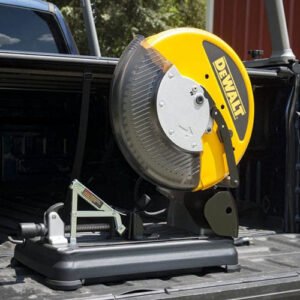
Abrasive chop saws use an abrasive wheel rather than a toothed blade. They are widely associated with cutting steel, structural sections, bars, rods, tubing and other metal stock. Their straightforward cutting action can make them useful for demanding workshop and fabrication applications.
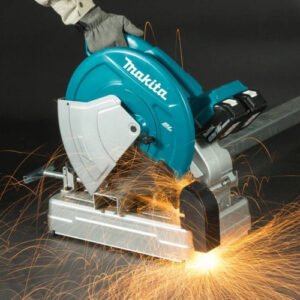
Abrasive cutting can produce sparks, heat, debris and a different edge finish from a toothed cold-cut blade. Buyers should therefore consider the surrounding work area and the required finish before selecting this type of machine.
Some machines are designed around multipurpose cutting systems that can handle several materials when the correct blade is fitted. These can be useful for buyers who want one corded saw for a broader range of workshop tasks.
Do not assume that a multipurpose saw can safely cut every material. Always check the manufacturer's stated material compatibility, blade requirements, maximum thickness and operating instructions for the exact model.
Specifications provide the most useful starting point when comparing advanced corded metal cutting saws, but individual figures should be considered together rather than in isolation.
Motor power can provide an indication of the machine's capacity, but a higher wattage figure does not automatically mean a saw will deliver better results for every application. Cutting performance is influenced by blade design, gearing, motor characteristics, workpiece geometry, feed rate and the machine's overall design.
Australian buyers should also confirm the electrical requirements of the exact product. Check the rated voltage, frequency, plug configuration, power consumption and any manufacturer-specific electrical requirements before purchase. Products intended for another market may not be suitable for Australian mains power.
Blade diameter is directly related to the cutting system and potential cutting capacity. A larger blade does not necessarily produce a better cut, because the machine must be designed to operate correctly with that blade size.
Never fit a blade simply because its diameter appears compatible. Arbor dimensions, maximum rotational speed, blade construction, kerf, tooth configuration and material compatibility must also match the saw.
No-load revolutions per minute indicate how quickly the blade or cutting wheel rotates when the machine is not cutting material. This figure can help when comparing machines, but it should not be interpreted as the actual cutting speed under load.
The appropriate operating speed depends on the cutting technology and blade. Using an unsuitable blade or operating accessory can create poor cutting performance and may introduce safety risks.
Cutting capacity is one of the most important specifications for metal fabrication. Manufacturers may provide separate capacities for square tubing, rectangular sections, round stock, angle iron and flat material.
Pay attention to the cutting capacity at different angles. A machine may have a larger maximum capacity for a straight 90-degree cut than for an angled cut. If your projects regularly involve mitre joints, compare the published capacities at the angles you actually intend to use.
A useful mitre mechanism can significantly expand the applications of a metal cutting saw. Common workshop requirements include straight cuts as well as angled cuts for frames, brackets, supports and fabricated assemblies.
When comparing mitre systems, look at the available angle range, adjustment mechanism, locking arrangement, scale visibility and repeatability. A clear, secure adjustment system is generally more useful than a complicated mechanism that is difficult to set accurately.
The blade mounting system must match the saw and the replacement blades you intend to use. Check arbor diameter and any required washers, adapters or mounting hardware before buying additional blades.
This is particularly important when moving between proprietary accessories and widely available aftermarket options. A blade that appears physically similar may still be unsuitable because of its mounting dimensions, speed rating or intended application.
The blade is effectively a cutting interface between the machine and the workpiece. Selecting the correct blade can have a substantial effect on cut quality, operating life and overall usability.
Steel can encompass mild steel, structural steel, hardened components and numerous specialised alloys. Blade selection should therefore be based on the specific material and thickness rather than simply choosing an accessory labelled for metal.
For repeated fabrication work, consider how quickly the blade can make the required cuts, the desired edge condition, expected blade life and the cost and availability of replacement blades.
Stainless steel can require more careful cutting practices than ordinary mild steel. The alloy, thickness and blade design all affect performance. A blade designed specifically for the intended stainless-steel application may be preferable to a general-purpose accessory.
Aluminium behaves differently from steel during cutting and may require a blade specifically designed for non-ferrous metals. Buyers should follow the saw and blade manufacturer's compatibility instructions rather than assuming that any metal-cutting blade is appropriate.
Square and rectangular hollow sections are common in fabrication, framing and general workshop projects. Cutting capacity should be assessed using the actual dimensions of the section, including wall thickness where relevant.
For repetitive production work, also consider how securely the workpiece can be clamped and whether the saw's vice and base accommodate the shapes you commonly cut.
A powerful motor cannot compensate for poor workpiece control. A robust vice or clamping mechanism is an important part of a metal cutting saw because it helps keep the material positioned during cutting.
When comparing machines, inspect the available clamping range, adjustment method, jaw design, locking action and compatibility with common stock shapes. A vice that accommodates different profiles can make a saw substantially more practical for mixed fabrication work.
Buyers should also consider whether the workpiece can be positioned consistently for repeated cuts. For production-style work, repeatability can matter just as much as maximum cutting capacity.
Metal cutting generates vibration and cutting forces. A stable base can help the operator maintain better control and may contribute to more consistent results.
When comparing advanced models, consider the construction of the base, hinge or pivot mechanism, vice mounting points, adjustment components and overall machine balance. A machine that is difficult to position securely can be inconvenient even if its headline specifications appear impressive.
Measure the available bench or floor area before purchasing a larger saw. Remember to allow additional clearance for the workpiece, operator movement, blade access and material feeding.
Long lengths of steel or tubing may require significantly more surrounding space than the saw itself occupies. This is especially relevant in smaller Australian garages and home workshops.
For many projects, the quality of the finished cut is more important than raw cutting speed. A clean, controlled cut can reduce the amount of secondary grinding, filing or preparation required before welding or assembly.
Cut quality can be affected by blade condition, blade type, material, feed pressure, workpiece support, clamping, machine alignment and operator technique. Consequently, buyers should be cautious about judging a saw solely by advertised motor power or cutting capacity.
Pay particular attention to edge quality when the cut will be visible, welded directly, fitted into a joint or used as part of a dimensionally controlled assembly. A saw that produces the required geometry consistently may be more valuable than one that simply cuts quickly.
Even a well-selected metal cutting saw can leave edges that require deburring. The amount of secondary finishing depends on the cutting technology, blade condition, material and application.
If you frequently prepare components for welding or assembly, include deburring time and equipment in your overall purchasing decision.
Metal cutting equipment should be evaluated with safety as a core buying criterion rather than as an afterthought. Look for a properly designed blade or wheel guard, secure workpiece clamping, stable machine construction and controls that can be operated without placing hands near the cutting zone.
A suitable guard should provide appropriate protection around the cutting accessory while allowing the machine to perform its intended operation. Do not modify, remove or bypass protective components to make cutting more convenient.
Compare the control arrangement and determine whether it is practical for the intended workspace. Features such as a lock-off mechanism, suitable switch placement or other manufacturer-designed controls can influence day-to-day usability.
Abrasive metal cutting can produce sparks and hot particles. Before buying, consider where those particles will travel and whether the intended work area contains combustible materials, vehicles, plastics, dust or other items that should not be exposed to sparks.
Appropriate eye and face protection, hearing protection, suitable clothing and other protective equipment should be selected according to the machine, material and manufacturer's instructions. Metal cutting can create sharp fragments, hot particles, noise and other hazards.
Different metal cutting technologies produce different types and quantities of debris. Toothed cutting systems may generate chips, while abrasive wheels can create substantial sparks and fine particulate matter.
Think about clean-up before choosing the machine. A saw that fits comfortably into your workflow should have a suitable location for cutting, material storage, debris collection and post-cutting maintenance.
Never assume that a standard household vacuum is suitable for collecting metal particles or sparks. Follow the equipment manufacturer's instructions for dust and debris management and use extraction equipment only where it is specifically appropriate.
The choice between corded and cordless equipment depends primarily on where and how you work.
The best corded metal cutting saw for a professional fabrication shop may not be the best choice for occasional home projects. Frequency of use should influence the importance you place on machine durability, accessory costs, cutting capacity and adjustment features.
Occasional users may benefit from a straightforward machine that handles the dimensions and materials they actually encounter. Paying for extremely high capacity can be unnecessary if most projects involve small tubing, brackets or light fabrication.
Frequent users should give greater weight to repeatability, clamping, adjustment, blade availability, maintenance requirements and the practical ergonomics of repeated cuts.
Professional users should evaluate the complete operating system rather than the saw alone. Consider compatible blades, spare parts, consumables, machine footprint, workflow integration and the manufacturer's documentation for the exact model.
A high power rating can look attractive in a comparison table, but it does not by itself establish superior cutting performance. Compare the entire specification set and make sure the machine is suited to the materials and dimensions you regularly cut.
A saw is only as practical as the cutting accessories you can obtain for it. Before purchasing, check whether compatible blades or wheels are readily available in Australia and whether there are suitable options for your principal materials.
Maximum capacity is useful, but it may not represent your typical workload. A machine with excellent capacity can still be inconvenient if its vice, adjustment system, footprint or accessory ecosystem does not suit your projects.
If you fabricate frames or angled assemblies, straight-cut capacity alone is insufficient. Check the manufacturer's published capacity at the angles you need.
Measure your workshop before choosing a heavy-duty saw. Include space for feeding long material and for safely operating the machine.
Metal-cutting blades differ in dimensions, construction, tooth geometry, speed ratings and intended materials. Use only accessories approved for the specific saw and application.
The purchase price is only one part of ownership. Replacement blades, abrasive wheels, maintenance items and other accessories can affect the long-term cost of using a metal cutting saw.
Well-known tool manufacturers can provide useful starting points for research, but brand reputation should not replace model-level comparison. Makita, DeWalt, Bosch, Evolution, Milwaukee and Metabo each offer different tool configurations, and specifications can vary substantially between products within the same brand.
When comparing two models from established manufacturers, examine the exact blade system, cutting capacities, electrical specifications, vice arrangement, mitre range, machine dimensions, weight, included accessories and manufacturer-approved replacement components.
For Australian purchases, also verify that the exact product configuration is intended for the Australian market. International model names can sometimes differ, and accessories supplied with one regional configuration should not automatically be assumed to apply to another.
Customer reviews can provide useful information about practical ownership, but they should be interpreted alongside the manufacturer's specifications and your own requirements.
Regular maintenance can help keep a metal cutting saw operating correctly and makes it easier to identify problems before they become more serious. Always follow the maintenance instructions supplied with the specific machine.
Check blades and wheels for damage, excessive wear or other conditions identified in the manufacturer's instructions. Do not continue using an accessory that should be replaced.
Remove accumulated chips and debris using a method appropriate for the machine and material. Pay particular attention to moving components, ventilation areas and the workholding system.
Make sure the vice, jaws and adjustment mechanisms remain in suitable condition. A secure workpiece is essential for controlled cutting.
Because the machine is corded, regularly inspect the power cable, plug and visible insulation for damage. If electrical components are damaged, follow the manufacturer's instructions and obtain appropriate qualified service rather than attempting unsafe repairs.
Unusual vibration, noise, movement or changes in operating behaviour should not be ignored. Consult the manufacturer's troubleshooting and service information for the specific machine.
Store the saw in a clean, dry location where the cutting accessory and electrical components are protected. Avoid placing heavy objects on the power cable or storing accessories in a way that could damage cutting edges.
A dedicated cutting area can make operation safer and more efficient. Position the saw so that the workpiece can be supported on both sides where necessary and so that the operator does not have to reach awkwardly across the cutting zone.
The word advanced should not be interpreted as simply meaning larger, heavier or more powerful. An advanced solution is better evaluated by how effectively its features solve the requirements of the intended user.
The cheapest machine is not necessarily the lowest-cost option over its useful life, while the most expensive model may provide features that an occasional user never needs. A better comparison considers the total ownership proposition.
Compare the initial price with replacement blade or wheel costs, accessory availability, required maintenance, machine capacity and expected frequency of use. For regular fabrication, productivity and repeatability may justify a more capable machine. For occasional DIY work, a simpler specification may provide better value.
When shopping for a corded metal cutting saw in Australia during 2026, check the exact product listing rather than relying on an old specification or a similarly named overseas model. Product configurations, included accessories, retailer stock and pricing can change.
Before completing a purchase, compare the current specifications from the manufacturer with information provided by the retailer. Confirm the electrical configuration, blade dimensions, cutting capacity, included accessories and intended application.
For Australian buyers, it is also sensible to consider where replacement cutting accessories will be sourced. A machine that initially appears attractive can become less convenient if its required consumables are difficult to obtain.
When reviewing a shortlist of advanced corded metal cutting saws, use the same criteria for every model. This avoids giving excessive weight to a single specification.
For metal framing, look closely at mitre capability, repeatable positioning and the ability to securely clamp tubing and structural sections. A stable vice and clear angle adjustment can be particularly useful when producing multiple matching components.
For general maintenance tasks, versatility may be more valuable than extreme cutting capacity. Consider the range of common stock sizes you expect to encounter and choose a machine that handles those materials without unnecessary complexity.
DIY users should focus on ease of setup, suitable capacity, safe workholding and availability of compatible blades. There is little benefit in selecting a machine with specialist capabilities that will rarely be used.
For repetitive work, prioritise consistency. Examine the vice, angle adjustment, material support and the ease of making repeated settings. Consumable availability becomes increasingly important as cutting frequency increases.
There is no single best model for every Australian buyer. The appropriate choice depends on the material, maximum dimensions, cutting method, frequency of use, required finish, workshop space and budget. Compare the exact specifications of shortlisted models against your actual workload.
Yes, a corded model can remain a practical choice where reliable mains power is available and extended cutting sessions are expected. The absence of battery charging can be an advantage in a fixed workshop environment.
Neither technology is universally better. Cold-cut systems may appeal when controlled cuts and reduced heat generation are important, while abrasive saws can be useful for applications where abrasive cutting is appropriate. Compare the technology with the materials, finish and workflow you require.
Some models and blades are designed for stainless steel, but compatibility depends on the specific machine and cutting accessory. Always check the manufacturer's instructions and the blade manufacturer's material recommendations.
No. Blade diameter, arbor dimensions, maximum rated speed, construction and material compatibility all need to be suitable for the exact machine. Use only accessories that meet the manufacturer's requirements.
A larger blade can be associated with greater capacity in some machines, but cutting capacity depends on the complete mechanical design. Always use the manufacturer's published capacity for the exact model.
Look at the clamping range, jaw configuration, adjustment mechanism, locking strength and ability to hold the profiles you commonly cut. If you perform repetitive work, also consider how easily the vice can be adjusted consistently.
Mitre capability is highly useful for users who fabricate frames, brackets and angled assemblies. If you only make straight cuts, it may be less important. Match the angle range and capacity to your actual projects.
Neither should be considered independently. Power, blade system, gearing, cutting capacity and machine construction work together. Start with the largest and most common materials you need to cut, then compare machines capable of handling them.
Weight can contribute to stability, but it also affects portability and storage. A heavy machine is not automatically superior. Consider the balance between stability, construction, capacity and how frequently the saw needs to be moved.
Maintenance intervals depend on the model and frequency of use. Follow the manufacturer's maintenance schedule and inspect the cutting accessory, guards, workholding system, cable and moving components regularly.
Before selecting one of the top corded metal cutting saw solutions for your Australian workshop, run through this checklist:
The best advanced corded metal cutting saw is the one that matches your material, cutting dimensions, workload and workshop environment rather than the one with the most impressive specification on paper. Start by deciding between abrasive, cold-cut and multipurpose technology, then compare cutting capacity, blade compatibility, workholding, mitre adjustment, electrical requirements, safety features and ongoing consumable costs.
For Australian buyers, always verify the exact 2026 model configuration and current specifications before purchasing. Brands including Makita, DeWalt, Bosch, Evolution, Milwaukee and Metabo can all be useful starting points for comparison, but the final decision should be based on the specifications and accessories of the individual machine.
Use the comparison criteria in this guide to narrow the available choices, check current retailer information and customer feedback, and select the corded metal cutting solution that provides the right balance of cutting capability, control, practicality and long-term value for your workshop.